GEOTECHNICAL ENGINEERING1
TAURANGA
HomeLaboratoryAtterberg limits

Atterberg Limits Testing for Tauranga Soils – Lab & Field Expertise

Practical geotechnics, field-tested.

LEARN MORE

When we receive samples from the Papamoa coastal strip or the Te Puke hinterland, the first thing we check is the fines fraction. Tauranga’s geology is dominated by the Pliocene-age Matua Subgroup, producing thick sequences of silts and clays interbedded with volcanic ash layers. Our laboratory team runs the Atterberg limits test not as a routine checkbox, but as the critical link between soil classification and the engineering behaviour expected on site. The liquid limit, plastic limit, and plasticity index are fundamental parameters for assessing the workability of these materials, which often arrive at the lab still carrying the moisture signature of the Bay of Plenty’s high-rainfall environment. For deep excavations in the Te Papa peninsula, we often pair these results with a triaxial test to capture the undrained shear strength of the saturated cohesive layers.

A plasticity index above 25% in Tauranga’s volcanic-derived soils signals potential volume change issues that standard bearing capacity calculations will miss.
Our service areas

Methodology and scope

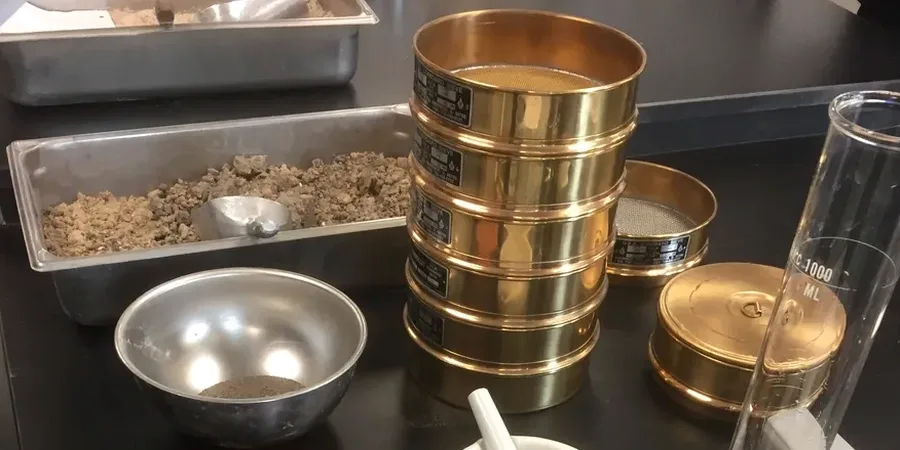
A common mistake we see on Tauranga projects is classifying a soil based purely on its grain size distribution, skipping the plasticity analysis. A silty sand with just 15% fines can behave like a plastic clay if those fines are derived from weathered rhyolitic tephra, a scenario we encounter regularly with the Hamilton Ash beds. Our procedure follows the NZGS guidelines precisely: we dry the sample, sieve through the 425µm mesh, and determine the liquid limit using the Casagrande cup method with incremental blow counts between 15 and 35. The plastic limit is then established by rolling threads to 3mm diameter. We’ve learned that Tauranga’s alluvial clays from the Wairoa River floodplain demand extra attention during the rolling phase because their mineralogy can produce false plastic limits if the technician rushes the process. The resulting plasticity index feeds directly into the NZS 3404 classification system, and where we suspect expansive behaviour, we recommend complementing the analysis with a grain size distribution to confirm the clay fraction percentage.
Atterberg Limits Testing for Tauranga Soils – Lab & Field Expertise
Technical reference — Tauranga

Local ground factors

Tauranga sits in a climatic zone where annual rainfall exceeds 1,200 mm, and the groundwater table in low-lying areas like Matapihi and Judea often sits within a metre of the surface. This persistent moisture regime means the natural water content of foundation soils frequently approaches the liquid limit. In our lab, we have tested samples from Harbour Drive excavations where the liquidity index exceeded 0.9 — the material was essentially a viscous fluid, not a solid. Construction plant working on such soils without prior Atterberg characterisation risks complete loss of bearing capacity, differential settlement, and in the worst cases, slope failures during trenching. The plasticity index also serves as a screening tool for liquefaction susceptibility: soils with a PI below 12% in the Bay of Plenty’s seismic environment warrant further investigation under the NZGS Module 4 framework.

Need a geotechnical assessment?

Reply within 24h.

Email: contact@geotechnical-engineering1.co

Reference standards

NZS 3404: Methods of Testing Soils for Civil Engineering Purposes, NZS 4203: General Structural Design and Design Loadings, NZGS Guidelines: Module 2 – Field Classification and Description of Soils, NZGS Guidelines: Module 4 – Geotechnical Site Investigation Requirements

Typical values

ParameterTypical value
Liquid Limit (LL)Determined via Casagrande cup, 15–35 blows for groove closure
Plastic Limit (PL)3 mm thread rolling method at 20°C controlled environment
Plasticity Index (PI)Calculated as LL minus PL, reported to nearest integer
Liquidity Index (LI)Computed from in-situ moisture content supplied with sample
Sample PreparationOven-dried at 60°C maximum, sieved through 425µm
Classification StandardNZS 3404 unified classification, Casagrande plasticity chart

Quick answers

What do Atterberg limits tell me about a Tauranga clay?

The liquid limit and plastic limit define the moisture range over which the soil behaves as a plastic material. A high plasticity index — common in weathered volcanic ash soils around Welcome Bay — indicates a greater capacity for volume change during wetting and drying cycles. The liquidity index, which requires the in-situ moisture content, tells us how close the soil is to its liquid state in the field. Together, these values inform foundation design, excavation support, and earthworks specifications under NZS 3404.

How much does Atterberg limits testing cost in Tauranga?

Our standard suite covering liquid limit, plastic limit, and plasticity index ranges from NZ$110 to NZ$190 per sample, depending on the number of samples and whether the in-situ moisture content and liquidity index calculation are included. We offer project-based rates for subdivision investigations where sample volumes exceed 20 units.

How long does the Atterberg limits test take?

From sample receipt to final report, the standard turnaround is 3 to 4 working days. The drying phase adds a day because we oven-dry at 60°C — not higher — to avoid altering the clay mineralogy. Rush analysis with a 48-hour turnaround is available for urgent construction decisions, such as confirming trench backfill suitability when rain is forecast.

Can you test samples with visible organic content?

Yes, but with important caveats. Organic soils from Tauranga’s wetland margins and former peat bogs require a different preparation protocol. We note the organic content and often recommend loss on ignition testing in parallel, because the standard Atterberg procedure was developed for inorganic soils and organic matter can artificially inflate the liquid limit. The NZGS field classification guidelines provide clear decision trees for these cases.

Location and service area

We serve projects in Tauranga and surrounding areas.

View larger map